Print

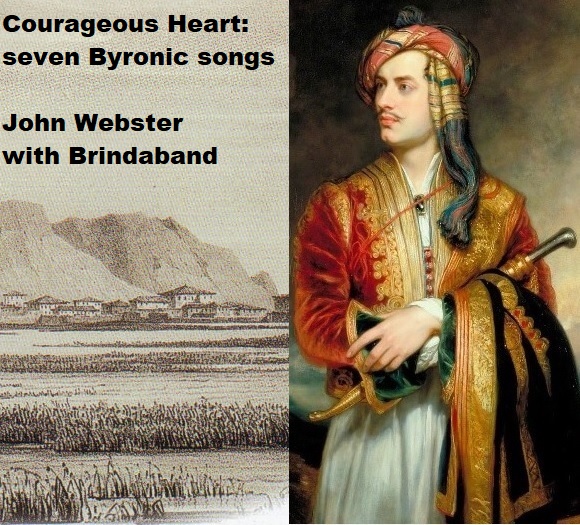
Byron EP COVER 2026e


Lyrics and context


LORD B. IN MOTION
Lyrics by John Webster
 
 Through the valley of the Arno
In the late October sun;
Lord Byron was a-travelling
While ahead his fame did run …
 
‘Lock up your daughters
Or keep them chaperoned;
He’s mad, he’s bad
He’s dangerous to know’
 
‘Don’t even look at him darling’
The mothers would say;
But their daughters sneaked a glimpse
Through the window anyway
 
At the head of five coachloads
Nine horses followed on the road
With an Egyptian falcon and a monkey;
There were five fine cackling geese
He hadn’t had the heart to eat
And a bulldog and a mastiff
 
His accountant was coiled like a snake
On his money chest;
His four poster bed was adorned
With his family crest
Which read from Norman times ‘Trust Byron’
(Not all his ladies would agree).
 
Byron: ‘I have simplified my politics
into an utter detestation of all governments’
‘Gin and water is the source of all my inspiration’
‘God will not always be a Tory’
 
He thought that the poet laureate
Was a turncoat and a fool;
He satirised him in his verse
And challenged him to a duel.
 
‘Lock up your daughters
Or keep them chaperoned;
He’s mad, he’s bad
He’s dangerous to know’
 
When Byron’s poem Childe Harold's Pilgrimage was published in March 1812
it triggered a response that can be compared to Beatlemania.
‘I awoke and found myself famous’ Byron recorded, also remembering
many years later that ‘the number of anonymous love letters and portraits I received,
and all from English ladies, would have been enough to fill a large volume’.
Byron rode the wave of his fame in Britain (also developing an international reputation)
until 1816, when London high society turned against him, scandalised by
the implosion of his marriage and  suspicions that he had conducted an incestuous affair
with his half sister Augusta.
 
After his exile public interest in him remained strong, and ‘Lord B. in motion’
tries to convey the extent of his celebrity.  The ‘don’t even look at him’ line
was addressed by an English  mother to her daughter in Florence
as Byron was passing through on his way to Pisa and gives an idea
of how he was regarded by polite society.
 
The final verse refers to his ongoing literary warfare with Robert Southey
the poet laureate (part of the no-holds-barred literary battle of the time).
Southey, who had supported liberal causes in his youth, had dubbed
Shelley and Byron (and Leigh Hunt), who were planning
to launch a journal in Pisa, ‘The Satanic School’,
and had called for legal action against them.
 
 
HALF A SCOT BY BIRTH
Adapted from Don Juan,
Canto X, Stanzas 18 and 19
 
I am half a Scot by birth
And bred a whole one …
‘Auld Lang Syne’ brings Scotland, one and all
Scotch plaids, Scotch snoods, the blue hills and clear streams
The Dee, the Don, Balgounie brig’s black wall,
All my boy feelings, all my gentler dreams
Floating past me …
 
You may remember, in a youthful fit
I railed at Scots – to show my wrath and wit
And yet, I ‘scotched, not killed’ the Scotsman in my blood -
I love the land of ‘mountain and of flood’.
 
I am half a Scot by birth …
And bred a whole one …
Auld Lang Syne brings Scotland, one and all
Scotch plaids, Scotch snoods, the blue hills and clear streams
The Dee, the Don, Balgounie brig’s black wall,
All my boy feelings, all my gentler dreams
Floating past me …
 
This childishness of mine
Comes back with ‘Auld Lang Syne’ …
 
After Shelley’s death in the summer of 1822 Byron took up his poem
Don Juan again, and in these lines, written in his study in Pisa at the Palazzo Lanfranchi,
overlooking the river Arno, he thinks back to his childhood in Aberdeen.
To visit the Dee valley (and the Linn of Dee near Braemar he visited as a child)
is to understand something about Byron, the grandeur, beauty and wildness of the scenery
he encountered in boyhood seeming to have permeated his spirit in some way. 
 
The lines about his ‘youthful fit’ refer to his poem
‘English Bards and Scotch Reviewers’,
a savage attack on both the Scottish and English literary worlds.
The Edinburgh Review, the liberal journal which he would have expected
to be supportive, had trashed his first published poem ‘Hours of Idleness’.
His first reaction had been complete despair but then, as he
recalled later, ‘I drank three bottles of wine and sat down
to make a reply’.
 
So ‘Half a Scot by birth’ amounts to public act of reconciliation
and a farewell to the Scotland he would never see again.
 
MARATHON
Sources: Don Juan Canto III, Stanza 86
Childe Harold Canto III, Stanza 98
Entry in notebook 19th June 1823
 
 The mountains look on Marathon
And Marathon looks on the sea;
And musing there an hour alone
I dreamed that Greece might still be free
 
Yet freedom ! yet thy banner torn but flying
Streams like the thunderstorm against the wind;
Yet freedom ! yet thy banner torn but flying
Streams like the thunderstorm against the wind.
 
The dead have been awakened – shall I sleep ?
The world’s at war with tyrants – shall I crouch ?
The harvest’s ripe - and shall I pause to reap ?
I slumber not – the thorn is in my couch ....
 
Each day a trumpet soundeth
Its echo in my heart ....
 
The mountains look on Marathon
And Marathon looks on the sea;
And musing there an hour alone
I dreamed that Greece might still be free
 
‘I would do anything for the land which gave Europe its science and its art’
said Byron in Pisa, as well as telling Shelley’s cousin Tom Medwin
‘I mean to return to Greece, and shall in all probability die there’.
 
 In Genoa, where he moved after leaving Pisa in the autumn of 1822,
he assisted two German volunteers returning from Greece,
and this rekindled his interest in supporting the insurrection of Greek nationalists,
who had risen to try to end four centuries of rule by the Ottoman empire.
When two emissaries from the London Greek Committee visited him
and asked for help his mind was made up. The lines from his notebook
‘The dead have been awakened ...’ were written a month before departure,
and convey his mental preparation for what lay ahead.
 
 
SETTING SAIL FROM GENOA
Lyrics by John Webster
 
Setting sail from Genoa
With a chest of gold and medicines,
To join the Grecian fight for liberty;
Sailing slowly southwards
Past the volcanic islands
And out beyond the heel of Italy.
 
It was as if ten long years
Were lifted from his shoulders,
He felt like he was young again;
And Byron then remembered
The Springtime of his manhood
And the women who had loved him then ....
 
After twenty days on board
They saw the mountains of Morea,
Rising wreathed in cloud above the sea;
And Byron came on deck then
To catch sight of the country
Where he thought he could well meet his destiny ....
 
Everyone was watching
On the isle of Cephalonia
When Byron's boat moored at Argostoli,
Through telescopes and glasses
They viewed the noble poet
Whose life had now become legendary.
 
 
And so Byron left Genoa in July 1823, planning to sail to Cephalonia,
then under a British mandate, to wait for firm information on the situation in Greece. 
He had chartered The Hercules, ‘a tub built on the lines of a baby’s cradle’
according to Trelawny, and captained by Captain Scott, a Cockney
who ‘abused Byron most obstreperously for throwing himself away on these villains’
- the Suliotes who swarmed onto the ship when Byron arrived in Cephalonia –
‘when there were so many honest men suffering at home’.
Byron and Trelawny teased the Captain during the journey by
getting into his prize scarlet waistcoat, taking one arm each
(he was so large they both fitted) and jumping into the sea with it.
 
When they arrived on Cephalonia Trelawny, impatient with
what he saw as Byron’s vacillation, went on ahead to the mainland,
where – completely misreading the situation - he immediately joined up with
the treacherous warlord Odysseus and was nearly assassinated for his pains.
Byron however, waited for hard news from the mainland – demonstrating
the blend of scepticism and idealism that underlay his expedition.
 
 
(LORD BYRON’S) FREEDOM SONG
Adapted from lyrics in a letter dated November 5th 1820;
music by Dave Eastoe
 
When there is no freedom to fight for at home
Let one combat for that of ones neighbours;
And think of the glory of Greece and of Rome ….
And get knocked on the head for ones labours !
 
Finally in January 1824 Byron arrived in the coastal town of Missolonghi
to throw his weight behind one part of the Greek forces,
the ‘Provisional government of western Greece’. There he began
to try to unite the different factions in the town and the country,
to shore up Missolonghi’s defences and raise a loan from banks in London
for the Greek cause. But on 24th April he succumbed to cerebral malaria.
 
‘The news of his death came upon London like an earthquake’
a journalist wrote. ‘No one could remember the death of a poet
having such an effect’. Another comment was:‘I felt as if I had
lost a friend – he was the noblest spirit in Europe’.
 
The piece of Byronic wit in (Lord Byron’s) Freedom Song was
written in Ravenna when he was providing assistance to Italian nationalists
who wanted to rid Italy of rule by Austro-Hungarian Empire.
It demonstrates how he would build up a noble or heroic theme
only to undercut or subvert it. He did this to the great lines ‘The mountains look on Marathon...’
from Don Juan and also when he wrote his tribute to the Ukranian patriot Mazeppa.
Both admirers, critics, and those who met him routinely complained
that he would never stick to a point of view, but when it came
to the point in Greece, he would stand by the cause to the bitter end.
 

EPITAPH

Adapted from Childe Harold Canto IV Stanza 137
But I have lived, and have not lived in vain
My mind may lose its force, my blood its fire;
But there is that within me which shall tire
Torture and time, and breathe when I expire
Like the remembered tone of a mute lyre.
 
In 1818 Byron had published the last Canto of Childe Harold’s Pilgimage,
in which he included a reflection on what his legacy could amount to.
 In an age when belief in an afterlife is on the wane these lyrics point to
an immortality of the spirit which certainly a great poet like Byron can aspire to.
What survives of the rest of us is perhaps less measurable,
but at best is seen perhaps in a diffused but none the less real contribution
to humanity, liberty, and society, that goes on to build up the human story
– for all we know, the only self-aware form of life in the universe.
 
SO WE'LL GO NO MORE A ROVING
Written in Venice in 1819
 
So, we'll go no more a roving,
So late into the night;
Though the heart be still as loving
And the moon be still as bright.
 
For the sword outwears its sheath
And the soul outwears the breast;
And the heart must pause to breathe
And love itself have rest
 
Though the night was made for loving
And the day returns too soon
Yet we’ll go no more a roving
By the light of the moon.
 
Though the night was made for loving
And the day returns too soon
Yet we’ll go no more a roving
By the light of the moon.
 
One of Byron’s most famous lyrics, whose jumping off point was
a contemporary Scottish folk song.
 
John Webster: vocals; Dave Eastoe: Guitars, keyboards, bouzouki;
Ruth Murray: Vocals, flute; Steve Homes: flamenco guitar; Keith Parker: Guest vocals


See also: THE CLOSEST THING IN HISTORY Chapter 14
Byron and Greece: a poet's fight for Freedom 

Further reading:

BYRON The Flawed Angel, by Phyllis Grosskurth. Perceptive modern biography.

The Last Attachment, by Iris Origo. The classic description of Byron and Teresa’s relationship.

The Last Journey, by Harold Nicolson. An in-depth account of his journey to Greece.

That Greece Might Still be Free, by William St. Clair. An account of the involvement of Philhellenes,

including Byron, in the Greek War of Independence.

Lord Byron: Detached Thoughts, Don Juan, The Curse of Minerva

Edward Trelawny: Records of Shelley, Byron and the Author