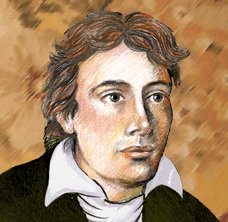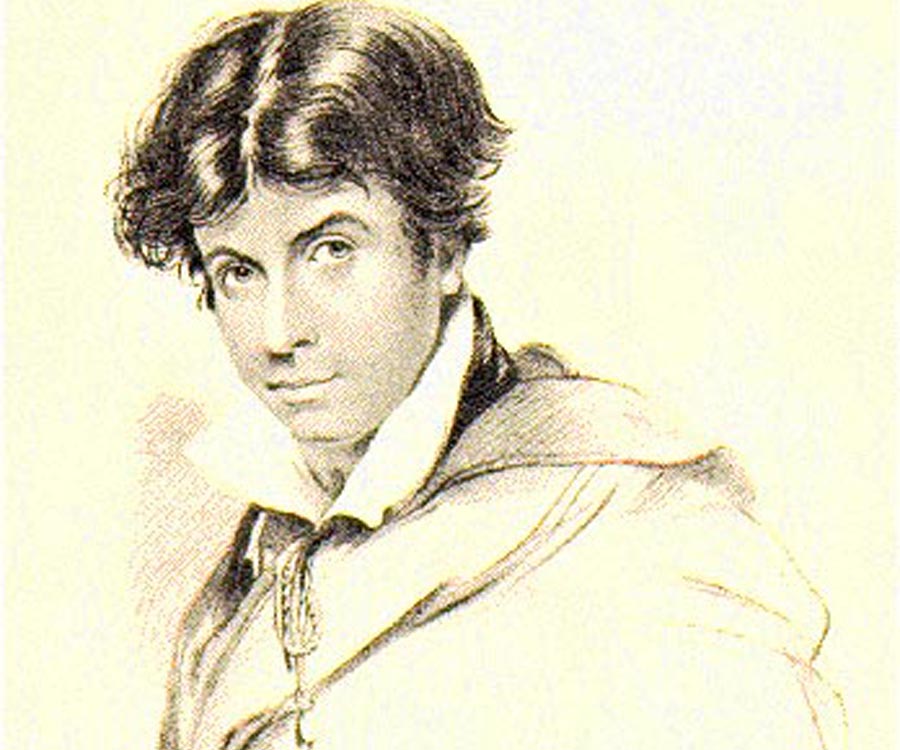
Songs that draw on around
two dozen Shelley poems and give access
to the poet’s empowering lyrical genius.
Click cover to download
Streaming now - listen on Spotify
SONG LYRICS AND NOTES
Sources: Lines written in the Euganean Hills
Stanzas written in dejection, near Naples
Hellas
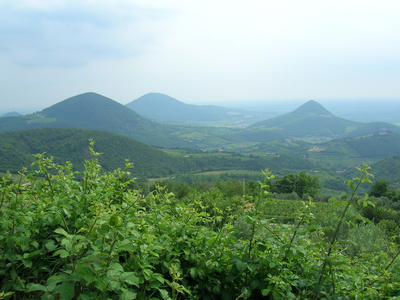
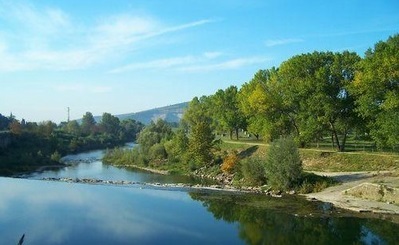
(View of the Euganean Hills)
Many a green isle needs must be
In the deep wide sea of misery
Or the mariner worn, and wan
Never thus could voyage on
Day and night, and night and day
Drifting on his dreary way
Alas I have nor hope nor health
Nor peace within, nor calm around
Nor that content surpassing wealth
The sage in meditation found
And walked with inward glory crowned
Many a green isle needs must be
In the deep wide sea of misery
Or the mariner worn, and wan
Never thus could voyage on
Yet were life a charnel where
Hope lay coffined with despair
Yet were truth a sacred lie
Love were lust, if liberty
Lent not life its soul of light
Hope its iris of delight
Truth its prophets robe to wear
Love its power to give and bear
Many a green isle needs must be
In the deep wide sea of misery
Or the mariner worn, and wan
Never thus could voyage on
Shelley’s years in Italy were marked by personal tragedy,
and the main chorus of this song was written in Este in 1818
in the Euganean hills after the death of his young daughter Clara in Venice.
The lines written in Naples were also written at a time of personal difficulty,
which scholars have not been able to fathom although it may be connected
with his mysterious `Neapolitan charge’. But the final lines from Hellas
reveal Shelley’s recourse to secular redemptive ideals based on liberty;
which he saw as more soundly based than religious beliefs.
RISE LIKE LIONS (SHELLEY)
Sources: Song to the Men of England,
The Mask of Anarchy
The motto on a small box kept by Shelley in Italy
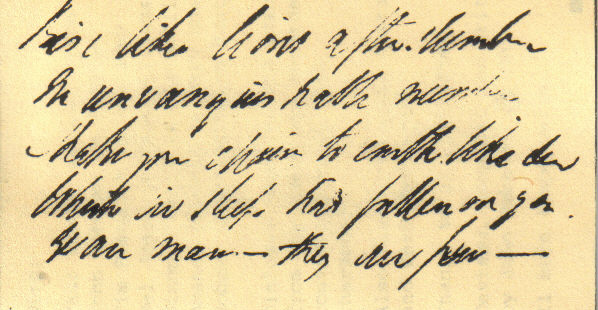
The final verse of the Mask of Anarchy from Shelley's manuscript
People of England wherefore plough
For the Lords who lay ye low ?
Wherefore weave with toil and care
The rich robes your tyrants wear?
The seeds ye sow another reaps
The wealth ye find, another heaps
The robes ye weave another wears
The arms ye forge another bears
Wherefore feed and clothe and save
From the cradle to the grave
These ungrateful drones who would
Drain your sweat, nay drink your blood
Rise like lions after slumber
In unvanquishable number
Shake your chains to earth like dew
Which in sleep had fallen on you
Ye are many they are few.
Ye are many they are few.
The political situation in Shelley's time was one of deadlock,
with the landowning classes monopolising political power and fearful
that the slightest reform would usher in violent revolution on the French model.
Changing social patterns, with Britain moving from a predominantly
agricultural society to an urban industrialising order, meant that
there was a new and increasingly literate – but entirely disenfranchised – urban population.
The Peterloo massacre led to the beginning of the organised labour
movement in Britain. Shelley's lyrics see him trying to bond
popular energies into a united force. As the Chartist Circular
of 19th October 1839 put it: 'He wrote to teach
his injured countrymen the great laws of union,
and the strength of the passive resistance'.
Shelley sent The Mask of Anarchy to his editor friend Leigh Hunt
but he did not publish it until after the Great Reform Bill in 1832.
Shelley's other post-Peterloo lyrics, which included his 'Song to the Men of England',
were also unpublished during his lifetime. They had to wait till 1839,
when Mary published an (almost) complete edition of his work.
In Tiananmen Square, before the crushing of the student/worker demonstration
for democratic rights in China, a radio reporter talked to a student who was telling
of her admiration for Shelley and Byron. So These Shelley lyrics still speak to
for situations where oligarchies assume power without popular mandate,
and demonstrate how Shelley remains a poet of global freedom.
WILD SPIRIT
Source: Ode to the West Wind
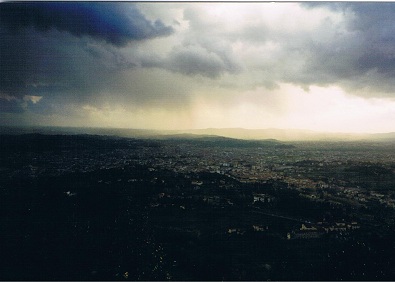
Clouds - 'the locks of the approaching storm' - gather over
Florence where Shelley wrote the Ode to the West Wind
Wild spirit, which art moving everywhere
Destroyer and Preserver, hear O hear!
A heavy weight of hours has chained and bowed
One too like thee: tameless and swift and proud
O wild West Wind, thou breath of autumn's being
The leaves are driven, like ghosts from an enchanter fleeing
Scatter as from an unextinguished hearth
Ashes and sparks, my words amongst mankind!
Wild spirit, which art moving everywhere
Destroyer and Preserver, hear O hear!
Scatter as from an unextinguished hearth
Ashes and sparks, my words amongst mankind!
Conventionally regarded as a nature lyric,
Shelley's Ode to the West Wind again has a political edge to it.
There's a theme of personal renewal in it too,
a refusal to be downed by the forces ranged against him.
So at the end his work will 'quicken a new birth'.
Elsewhere he wrote: 'the most unfailing herald, companion and follower
of the awakening of a great people to work a beneficial change
in opinion or institution, is poetry'.
THE WORLD'S GREAT AGE
Sources:
Hellas, Prometheus Unbound, Act III
The Question, Shelley’s Lerici notebook,
Lines written among the Euganean Hills
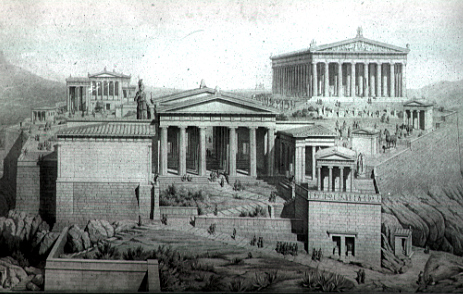
Illustration reconstructing 5th century Athens
- what Shelley saw, with some qualifications,
as 'The World's Great Age'.
The world's great age begins anew
The golden years return;
The earth doth like a snake renew
Her winter weeds outworn.
Heaven smiles, and faiths and Empires gleam;
Like wrecks of a dissolving dream.
The loathsome mask has fallen;
The man remains
King over himself
Free from guilt and pain
Women frank and beautiful and kind;
Looking emotions once
they feared to feel
Speaking the wisdom once they dared not speak
Changed to all which once they dared not be
I dreamed that as I wandered by the way
Bare winter suddenly was changed to spring
Let the tyrant rule
The desert he has made
Let the free possess
The paradise they claim
Where all shall live
As equals and as friends;
And the world grow young again.
The world's great age begins anew
The golden years return;
The earth doth like a snake renew
Her winter weeds outworn.
This song gathers together Shelley's utopian verses
from a variety of sources. Matthew Arnold derided Shelley
as an ‘ineffectual angel’ but modern historians
have shown how his visionary verses made a significant contribution
to the attainment of universal suffrage in Britain through their influence
on key groups like the Chartists and the Suffragettes.
So Shelley leaves this collection in idealistic mode.
He understood the value of a vision, but saw its achievement
as subject to 'the difficult and unbending realities of actual life'.
As he put it to Leigh Hunt in the dark days after the Peterloo massacre:
'You know my principles incite me to take all the good I can get in politics,
for ever aspiring to something more. I am one of those whom nothing
will fully satisfy,but who is ready to be partially satisfied
by all that is practicable'.
SPIRIT OF DELIGHT
Source: From an (untitled) Song
Rarely, rarely comest thou Spirit of Delight!
Wherefore hast thou left me now
Many a day and night?
Spirit false thou hast forgot
All but those who need thee not.
I love all thou lovest Spirit of delight !
The fresh earth in new leaves dressed
And the starry night Autumn evening and the morn
When the golden mists are born.
I love Love - though he has wings
And like light can flee,
But above all other things Spirit I love thee –
Thou art love and life ! oh come
Make once more my heart thy home.
This lyric is about being in what Shelley
called being in an 'interval of inspiration'. A strangely cheerful
song about sadness, it reminds you of the existence of that 'spirit of delight'
and its importance,and so achieves a positive emotional effect.
'Spirit of Delight' adds in the introspective side of Shelley's work
and shows how he examined emotional states.
It's edited down from eight verses to three,
with verse one finishing with
two lines from verse two.
HEART OF HEARTS
Sources: Dante's sonnet for Guido Cavalcanti (translated by PBS),
Epipsychidion, Lines for Emilia Viviani
Ah, my song; I fear but few
Fitly shall conceive thy reasoning
Of such hard matter doth thou entertain...
Amongst enchanted islands of sunlit lawn
In the clear golden prime of my youth's dawn
There was a being who my spirit oft
Met on its visioned wanderings far aloft
As one sandalled with plumes of fire
I sprang towards the lodestar of my desire
In many mortal forms I rashly sought
The shadow of that idol of my thought
I never was attached to that great sect
Whose doctrine is that each one should select
Out of the crowd a mistress or a friend
And all the rest to oblivion commend
There was a being who my spirit oft
Met on its visioned wanderings far aloft
Amongst enchanted islands of sunlit lawn
In the clear golden prime of my youth's dawn
The clear brow, the amorous lips
The eyes where past time reposes
These are images, images of her
The fragrance, yet still I seek the roses.
Henry Salt, author of Shelley: poet and pioneer, called Epipsychidion
'the despair of the critics' and it doesn't have the cohesion of Shelley's greatest work:
it blends courtly love, autobiography, sexual and platonic passion and a philosophy of love.
I would defend Epipsychidion though on the grounds that it fulfils the old maxim:
'Know yourself'. Shelley wrote to a friend shortly before his death that he could not
now bring himself to look at it, but that 'it will tell you something' about 'what I am and have been'.
'I think one is always in love with something or another', he added;
'the error, and I confess it is not easy for spirits cased in flesh and blood to avoid it,
consists in seeking in a mortal image the likeness of what is perhaps eternal'.
In the early 19th century divorce was virtually impossible and Shelley was
expected to 'marry well' for the sake of the family fortunes; his father told him
he would provide for as many illegitimate children as he cared to father
but would never forgive a 'misalliance'. Husbands had complete control
over any financial assets the wife brought to the marriage, and women
who had sexual relationships before or outside marriage were written off as fallen women.
At a dance in Horsham Shelley had deliberately danced with a girl so regarded.
Shelley's championing of free love was really a plea that people should be free to
realise themselves in this life with who they loved, rather than be stifled by law and convention.
Virginia Woolf wrote: 'Shelley, both as son and as husband, fought for reason and freedom
in private life, and his experiments, disastrous as they were in many ways,
have helped us to greater sincerity and happiness in our own conflicts'.
IMMORTAL DEITY
Sources: Queen Mab (adapted from notes)
The Defence of Poetry; Immortal Deity.
There is no God;
Or rather, there is no creative God.
The hypothesis of a pervading spirit,
Co-eternal with the universe
Remains unshaken.
This power arises from within:
Poetry redeems from decay
The visitations of the divinity in man.
Oh thou immortal deity
Whose throne is in the depth of human thought
I do adjure thy power and thee;
By all that man may be, by all that he is not
By all that he has been and yet must be !
An important part of Shelley's life, work and career is the challenge
he threw out to conventional religious orthodoxy.
He called himself an atheist – 'I took up the word, as a knight took
up a gauntlet, in defiance of injustice' he told Trelawny. Though he respected
Jesus of Nazareth as a teacher and moralist, he rejected the mythological element
and the Pauline superstructure of orthodox Christianity. Nor did he believe in
what he calls here a 'Creative God', i.e. a protective, caring/angry paternal god;
he was consistent in attacking this Judeo-Christian model. The result was that
he looked elsewhere for sources of morality - substituting what he regarded as
innate qualities of benevolence and love of justice and liberty that were inherent in people.
This song with lyrics from Queen Mab, A Defence of Poetry and
a fragment from his later years in Ialy, expresses a tentative sense
of a spirituality bound up with human potential – 'what men call God'
being a kind of spirit of wisdom/justice/liberty/creativity/poetry
that can visit anyone.The line referring to 'the hypothesis
of a pervading spirit, co-eternal with the universe' may have been a
reference to Sir William Jones's description
of Indian Vedantic philosophy.
His earlier poem 'Hymn to Intellectual Beauty' ploughs
the same furrow as this.Shelley took the phrase 'Intellectual Beauty'
from Mary Wollstonecraft who had written that women were primarily
valued for their 'soft bewitching beauty' – actually, she wrote,
there is something called 'intellectual beauty' as well.
The 'Hymn to Intellectual beauty' refers to a time in boyhood
when, as Shelley put it, 'thy shadow fell on me'; he added:
'I vowed that I would dedicate my powers
To thee and thine – have I not kept the vow?'
PARADISE OF EXILES
Sources: The Boat on the Serchio, Julian and Maddalo
Prose: Fragment on Beauty, Hellas,
Prometheus Unbound ms. fragment, Adonais
Day has awakened all things that be;
The lark and the thrush and the swallow free;
The stars burn out in the clear blue air
The thin white moon lies withering there.
Thou paradise of exiles, Italy !
A heron comes sailing over me...
Worlds on worlds are rolling ever
From creation to decay;
Like the bubbles on a river
Sparkling, bursting, borne away
Green and azure wanderer
Happy globe of land and air
The One remains, the many change and pass
Life, like a dome of many coloured glass
Stains the white radiance of eternity
This song consists of lines from Shelley's final
years in Italy, almost all composed in or around Pisa.
One of his boating expeditions during the summer of 1821
is described in 'The Boat on the Serchio'. The famous 'line paradise of exiles'
comes from Julian and Maddalo,written two years previously in Venice;
the line about the heron comes from
a piece of prose written during another of Shelley's boat trips.
The lines on the earth – 'green and azure wanderer' – owe
something to his fluency in Greek: the Greeks called
the planets 'wanderers' – the vagabonds of the solar system..
THE PINE FOREST
Sources:
The Indian Serenade
The Pine Forest of the Cascine near Pisa
When the lamp is shattered
To Jane: The Recollection


The pine forest near Pisa
I arise from dreams of thee
In the first sweet sleep of night;
When the winds are breathing low
And the stars are shining bright;
I arise from dreams of thee
And a spirit
in my feet
Has led me who knows how ?
To thy chamber window sweet
We wandered to the pine forest
That skirts the ocean's foam
The lightest wind was in its nest
The tempest in its home
How calm it was, the silence there
By such a chain was bound
That even the busy woodpecker
Made it stiller by its sound.
Love's passions will rock thee
Like the storms rock the ravens on high
Bright reason will mock thee
Like the sun from a wintry sky;
Though thou art ever fair and kind
The forests ever green,
Less oft is peace in Shelley's mind
Than calm in waters seen.
The final two verses belong to the last months of Shelley's life;
verse 1 was written in Florence in 1819.
The pine forest on the coast about 12 miles from Pisa
- visible from the air when flying into Pisa - was one of Shelley's writing haunts:
verse two commemorates a still day in February 1822 when
Shelley, Mary and Jane went walking there. The sea has receded
a mile or two since Shelley's time.
The final verse begins with four lines from 'When the lamp is shattered'
. That late lyric begins unseen with a shining lamp, the radiance of a love relationship.
Though the lyric seems to have been part of a play Shelley was working on
in the final phase of his life (titled by Mary 'Fragments of an unfinished drama')
It indicates perhaps how sorrowful Shelley had become about love
that the lamp is shattered at the outset of the poem.
Perhaps the memory of his first wife Harriet,
who had committed suicide after the breakdown of their marriage,
influences it; or perhaps it reflected the emotional distance
that had entered his marriage to Mary,
largely due to the loss of their children.
THE TRIUMPH OF LIFE
Shelley's last house, the Casa Magni in San Terenzo, Lerici
and the view from its balcony
Source: The Triumph of Life
Swift as a spirit
Hastening to his task
Of glory and of good;
The sun sprang forth
Rejoicing in his splendour.
Before me fled the night
Behind me rose the day,
The deep was at my feet
And heaven above my head
When a strange trance over my fancy grew
Which was not slumber
And then a vision on my brain was rolled ...
Methought I sate beside a public way
Thick strewn with summer dust
And a great stream of people there
Was hurrying to and fro
Numerous as gnats upon the evening gleam
Yet none seemed to know
Whither he went
Or whence he came
Or why he made one of the multitude
Struck to the heart by this sad pageantry
Then what is life I cried ......
This song amounts to a bit of creative editing – a poem of 544 lines
being edited down to about 14 ! It examines the difficulties of living
an ethically ideal existence, or achieving self knowledge, with the poem
maintaining that most, even Shelley's admired Plato, fall by the wayside –
betrayed by 'the mutiny within'.
In the poem Shelley meets the figure of Rousseau
who undertakes to explain the vision to him: it's interesting to compare
this with World War One poet Wilfred Owen's poem 'Strange Meeting'
which uses the same device and has much the same tone as The Triumph of Life.
Owen was highly influenced by Shelley's view of the role of the poet;
he was reading 'plenty of Shelley' just before his death.
TO JANE
The keen stars were twinkling,
And the fair moon was rising among them,
Dear Jane.
The guitar was tinkling,
But the notes were not sweet till you sung them
Again.
The stars will awaken,
Though the moon sleep a full hour later
To-night;
No leaf will be shaken
Whilst the dews of your melody scatter
Delight.
Though the sound overpowers,
Sing again, with your dear voice revealing
A tone
Of some world far from ours,
Where music and moonlight and feeling
Are one.
From the very last weeks of Shelley's life,
a recollection of an evening on the balcony of the Casa Magni.
From the same notebook that contained Shelley's draft
of The Triumph of Life, its mood has been described
as 'the desire for an impossible indefinite prolongation of
fleeting intervals of beauty and joy or regret for their passing'.
(Nora Crook, The Complete Poetry of Percy Bysshe Shelley Volume 7)
THE FUNERAL
(Lyrics by John Webster, from Trelawny's account)
The quarantine officers stopped me
And sent me back to the quay;
Nonetheless Shelley and Williams
Kept heading out to sea
I watched till they disappeared into the haze
Then went down to my cabin to sleep;
I was woken by thunder and lightning
Coming crashing down over the deep.
And when the storm had cleared away
I looked where their boat had last been
Then I scanned the entire horizon
But they were nowhere to be seen.
(Mary Shelley: with us it was stormy all day
and we did not at all suppose that they could
put to sea …. Next day it rained and was calm
– the sky wept on their graves…')
Two weeks on I was cantering over
The Mediterranean sands;
Despair in the pit of my stomach -
And sweat in the palms of my hands.
I was riding along for miles and for miles
I was brought up short when I saw;
The lifeless body of Shelley
Lying there on the shore.
I rode back to Lerici
And there told Mary and Jane
That Shelley and Ned had been taken from them
By the sea and the wind and the rain
Then I built an iron furnace
And carried it down to the shore
Prepared the cremation of Shelley
As a crowd gathered silent in awe.
The air seemed to quiver and glisten
Twixt the sea and the Apennine;
Over his burning body I poured
Frankincense, salt and wine.
'My dear Trelawny' said Byron
Breaking the funeral's spell;
'I knew that you were a pagan
But you're a pagan priest as well !'
But not till the evening was on us
Was his body consumed on the pyre
All was consumed, except for his heart
Which I snatched from out of the fire.
And Mary is left with his papers,
And a question; she wonders how long
It will take for the world to realise
What it lost in this bright child of song.
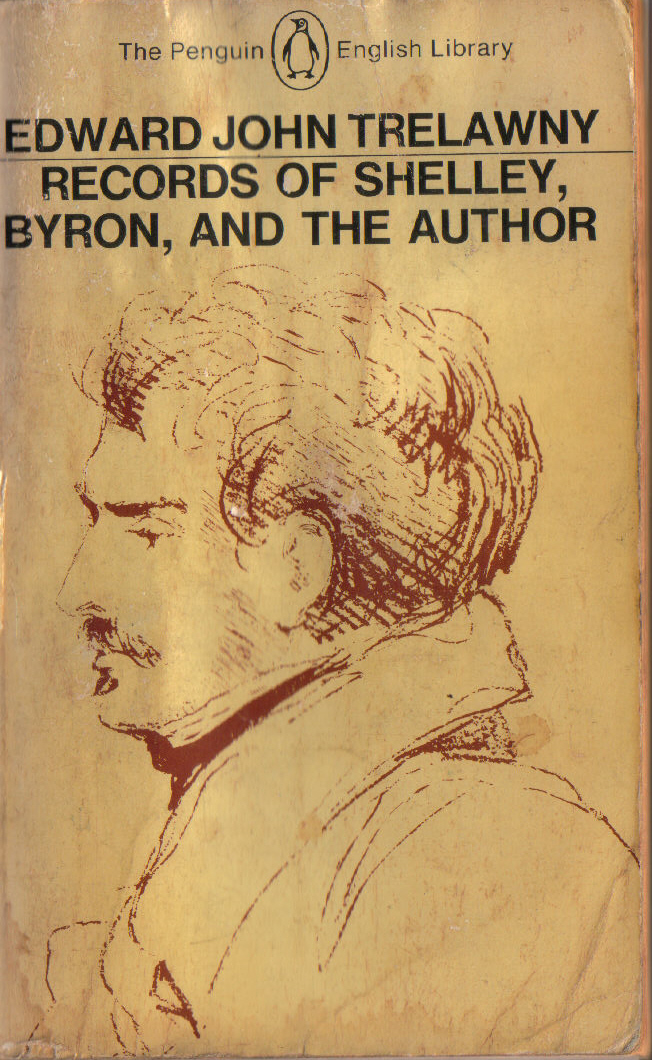
This song, sung by guest vocalist Keith Parker, summarises
Edward Trelawny's account of Shelley's death and his funeral
on the beach near Viareggio in his book 'Records of Shelley, Byron and the author'.
The Mary Shelley spoken piece over the instrumental is taken
from a letter she wrote to her friend Maria Gisborne from Pisa
as the funeral was taking place.
ADONAIS (SHELLEY)
Sources:
To Stella (adapted from Plato's epigram translated by Shelley)
Adonais, Ode to the West Wind
He was a morning star amongst the living;
Now that his spirit is fled;
He shines in the heavens
like the evening star
He gives new splendour to the dead.
He hath awakened from the dream of life
He hath outsoared the shadow of our night;
The soul of Adonais, burning like a star
Beacons from the abode where the eternal are.
(The spring does not rebel against the winter - it succeeds it;
The dawn does not rebel against the night - it disperses it.)
The One remains, the many change and pass
Life, like a dome of many coloured glass,
Stains the white radiance of Eternity.
O wind if winter comes can spring be far behind?
Can Spring be far behind?
O wind if winter comes can spring be far behind?
Can Spring be far behind?
O wind if winter comes can spring be far behind?
Can Spring be far behind?
This song may be the first time that Plato (in verse 1)
has ever been put to a backbeat! It's sung by Ruth Murray,
representing Mary Shelley paying tribute to her lost husband.
Two epigrams (thought to be) by Plato survive, evidence perhaps
of an early desire to be a poet/playwright.His evident failure
to succeed may have been why, in book 10 of The Republic,
he proposed banishing poets from his ideal state!
His epigram is a soulful tribute to a lost friend, Stella,
who 'gives new splendour to the dead'. The second verse, from Adonais,
plays on the old philosophical notion that perhaps this life is nothing but a dream.
The opening lines of Stanza 40 of Adonais
are followed by the two final lines of the poem.
Adonais often comes to mind when the young and gifted suffer an untimely death;
examples could include Brian Jones of the Rolling Stones (Mick Jagger read pieces
from Adonais at the concert in Hyde Park), River Phoenix, Kirsty McColl,
Stephen Lawrence, or John Lennon. You could see Lennon
in Shelleyan terms as an 'unacknowledged legislator'
who now 'shines in the heavens like the evening star'.
In his poem A Terre (Being the Philosophy of many soldiers)
Wilfred Owen referred to Adonais (see stanza 42):
'I shall be one with nature, herb and stone', Shelley would tell me.
Shelley would be stunned: The dullest Tommy hugs that fancy now.
'Pushing up the daisies is their creed, you know'.
The spoken fragment comes from Shelley's notebook from Lerici,
and is significant in that it repeats the central idea from the
Ode to the West Wind. In other words the grim vision from The Triumph of Life,
written at the same time as the fragment, is not (as some say) a final descent
into pessimism on Shelley's part, but part of a longer work in which
sources for hope in a secular world would have been explored.
The third verse is a reprise of the platonic verse from Paradise of exiles,
and the final chorus is from the last line of the Ode to the West Wind.
It brings out the link between the Ode to the West Wind and Adonais:
at the beginning of the final stanza Shelley wrote
'The breath whose might I have invoked in song/ Descends on me ….'
– a reference back to the west wind in Florence.
Shelley called death 'the great mystery' and once apparently,
suggested to Jane Williams, when they were in a little dinghy in the
bay of Lerici, that they 'solve the great mystery together'.
She replied 'no thank you I'd like my dinner first'!
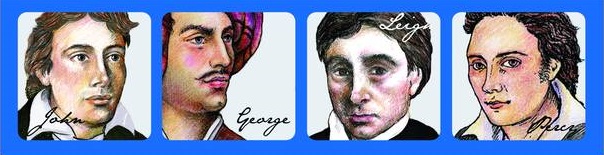
Click images for more on Shelley's fellow poets
TOGETHER THEY WERE THE FIRST FAB FOUR!