LYRICS AND NOTES
.
JENNY KISSED ME
Hunt: Jenny kissed me when we met,
Jumping from the chair she sat in;
Time you thief, who love to get
Sweets into your list, put that in !
Say I’m weary, say I’m sad,
Say that health and wealth have missed me,
Say I’m growing old, but add
Jenny kissed me.
Byron: She walks in beauty, like the night
Of cloudless climes and starry skies;
And all that’s best of dark and bright
Meet in her aspect and her eyes.
One shade the more, one ray the less,
Had half impaired the nameless grace;
Which waves in every raven tress
Or softly lightens o’er her face
Keats: I met a lady in the meads,
Full beautiful, a faery’s child;
Her hair was long, her foot was light
And her eyes were wild
She found me roots of relish sweet,
And honey wild and manna dew;
And sure in language strange she said ‘I love thee true’.
She took me to her elfin grot
And there she wept and sighed full sore
And there I shut her wild wild eyes
With kisses four
And there she lulled me asleep
And there I dreamed – Ah woe betide!
The latest dream I ever dreamed
On the cold hillside
I saw pale kings and princes too
Pale warriors, death-pale were they all;
They cried – ‘La Belle Dame sans merci
Has thee in thrall!’
And this is why I sojourn here
Alone and palely loitering
Though the sedge has withered from the lake
And no birds sing
Shelley: The fountains mingle with the river
And the river with the ocean;
The winds of heaven mix forever
With a sweet emotion,
And the sunlight clasps the earth
And the moonbeams kiss the sea....
What is all this sweet work worth
If thou kiss not me?
A medley of lyrics on the subject of love by all four poets.
Beginning with Leigh Hunt’s ‘Rondeau’, which as Hunt wrote,
'was written on a real occasion' and recalls a meeting with a lady
who 'was a great lover of books and impulsive writers'.
It moves to Byron’s famous verse inspired by a lady in a black spangled dress
on the dance floor (reminding him of the night skies he encountered
on his 1810 journeys through Albania, Greece and Turkey),
and then on to extracts from Keats’s story-poem ‘La Belle Dame Sans Merci’
which could be thought of as conveying the eternal truth that
matters of the heart are not always straightforward.
The song ends with the final verse from Shelley’s poem
‘Love’s Philosophy’, a charming way of asking for a kiss from a pretty girl.
LORD B. IN MOTION

(Lyrics by John Webster)
Through the valley of the Arno
In the late October sun;
Lord Byron was a-travelling
While ahead his fame did run …
‘Lock up your daughters
Or keep them chaperoned;
He’s mad, he’s bad
He’s dangerous to know’
‘Don’t even look at him darling’
The mothers would say;
But their daughters sneaked a glimpse
Through the window anyway
At the head of five coachloads
Nine horses followed on the road
With an Egyptian falcon and a monkey;
There were five fine cackling geese.
He hadn’t had the heart to eat
And a bulldog and a mastiff
His accountant was coiled like a snake
On his money chest;
His four poster bed was adorned
With his family crest
Which read from Norman times ‘Trust Byron’
(Not all his ladies would agree).
‘I have simplified my politics into an utter detestation of all governments’
‘Gin and water is the source of all my inspiration’
‘God will not always be a Tory’
He thought that the poet laureate
Was a turncoat and a fool;
He satirised him in his verse
And challenged him to a duel.
‘Lock up your daughters
Or keep them chaperoned;
He’s mad, he’s bad
He’s dangerous to know’
When Byron’s poem Childe Harold' Pilgrimage was published
in March 1812 it triggered a response that can be compared to Beatlemania.
‘I awoke and found myself famous’ Byron recorded,
also remembering many years later that ‘the number of
anonymous love letters and portraits I received, and all from English ladies,
would have been enough to fill a large volume’.
Byron rode the wave of his fame in Britain (also developing
an international reputation) until 1816,
when London high society turned against him,
scandalised by the implosion of his marriage and suspicions that
he had conducted an incestuous affair with his half-sister Augusta.
After his exile public interest in him remained strong, and
‘Lord B. in motion’ tries to convey the extent of his celebrity.
The ‘don’t even look at him’ line were addressed by an English mother
to her daughter in Florence as Byron was passing through on his way to Pisa
and gives an idea of how he was regarded by polite society.
The final verse refers to his ongoing literary warfare with Robert Southey
the poet laureate (part of the no-holds-barred literary battle of the time).
Southey, who had supported liberal causes in his youth,
had dubbed Shelley and Byron’s impending collaboration on a journal in Pisa
‘The Satanic School’, and had called for legal action against them.
Sources:
Don Juan Canto III, Stanza 86
Childe Harold Canto III, Stanza 98
Entry in notebook 19th June 1823
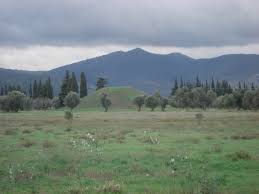
(Two views of Marathon, Greece, which Byron visited in 1810)
The mountains look on Marathon
And Marathon looks on the sea;
And musing there an hour alone
I dreamed that Greece might still be free
The mountains look on Marathon
And Marathon looks on the sea;
And musing there an hour alone
I dreamed that Greece might still be free
Yet freedom ! yet thy banner torn but flying
Streams like the thunderstorm against the wind;
Yet freedom ! yet thy banner torn but flying
Streams like the thunderstorm against the wind.
The dead have been awakened – shall I sleep ?
The world’s at war with tyrants – shall I crouch ?
The harvest’s ripe - and shall I pause to reap ?
I slumber not – the thorn is in my couch ....
Each day a trumpet soundeth Its echo in my heart ....
The mountains look on Marathon
And Marathon looks on the sea;
And musing there an hour alone
I dreamed that Greece might still be free.
‘I would do anything for the land which gave Europe its science
and its art’ said Byron in Pisa. In Genoa he assisted two
German volunteers returning from Greece which rekindled
his interest in supporting the Greek insurrection.
When two emissaries from the London Greek Committee
visited him and asked for help his mind was made up.
The lines from his notebook ‘The dead have been awakened ...’
written a month before his departure have a Churchillian ring to them,
conveying his mental preparation for what lay ahead.
RISE LIKE LIONS (SHELLEY)
Sources: Song to the Men of England,
The Mask of Anarchy
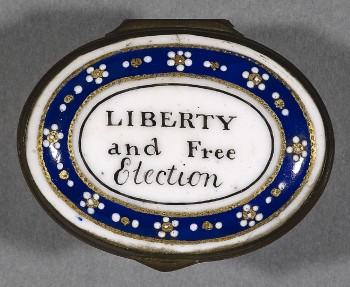
The motto on a small box kept by Shelley in Italy
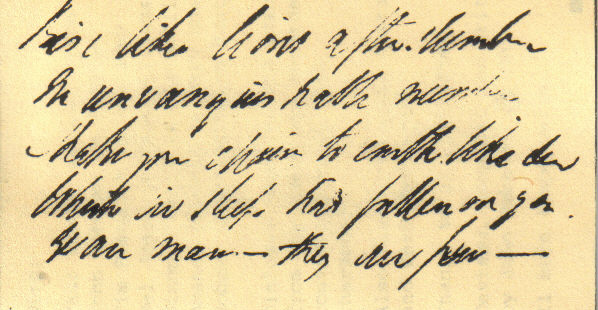
The final verse of the Mask of Anarchy from Shelley's manuscript
People of England wherefore plough
For the Lords who lay ye low ?
Wherefore weave with toil and care
The rich robes your tyrants wear?
The seeds ye sow another reaps
The wealth ye find, another heaps
The robes ye weave another wears
The arms ye forge another bears
Wherefore feed and clothe and save
From the cradle to the grave
These ungrateful drones who would
Drain your sweat, nay drink your blood
Rise like lions after slumber
In unvanquishable number
Shake your chains to earth like dew
Which in sleep had fallen on you
Ye are many they are few.
Ye are many they are few.
The political situation in Shelley's time was one of deadlock,
with the landowning classes monopolising political power and fearful
that the slightest reform would usher in violent revolution on the French model.
Changing social patterns, with Britain moving from a predominantly
agricultural society to an urban industrialising order, meant that
there was a new and increasingly literate – but entirely disenfranchised – urban population.
The Peterloo massacre led to the beginning of the organised labour
movement in Britain. Shelley's lyrics see him trying to bond
popular energies into a united force. As the Chartist Circular
of 19th October 1839 put it: 'He wrote to teach
his injured countrymen the great laws of union,
and the strength of the passive resistance'.
Shelley sent The Mask of Anarchy to his editor friend Leigh Hunt
but he did not publish it until after the Great Reform Bill in 1832.
Shelley's other post-Peterloo lyrics, which included his 'Song to the Men of England',
were also unpublished during his lifetime. They had to wait till 1839,
when Mary published an (almost) complete edition of his work.
In Tiananmen Square, before the crushing of the student/worker demonstration
for democratic rights in China, a radio reporter talked to a student who was telling
of her admiration for Shelley and Byron. So These Shelley lyrics still speak to
for situations where oligarchies assume power without popular mandate,
and demonstrate how Shelley remains a poet of global freedom.
WILD SPIRIT
Source: Ode to the West Wind
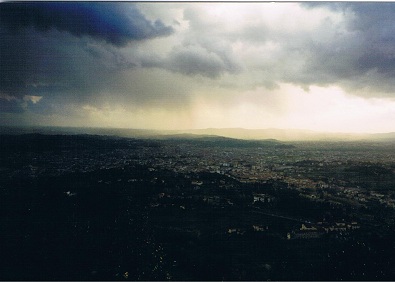
Clouds - 'the locks of the approaching storm' - gather over
Florence where Shelley wrote the Ode to the West Wind
Wild spirit, which art moving everywhere
Destroyer and Preserver, hear O hear!
A heavy weight of hours has chained and bowed
One too like thee: tameless and swift and proud
O wild West Wind, thou breath of autumn's being
The leaves are driven, like ghosts from an enchanter fleeing
Scatter as from an unextinguished hearth
Ashes and sparks, my words amongst mankind!
Wild spirit, which art moving everywhere
Destroyer and Preserver, hear O hear!
Scatter as from an unextinguished hearth
Ashes and sparks, my words amongst mankind!
Conventionally regarded as a nature lyric,
Shelley's Ode to the West Wind again has a political edge to it.
There's a theme of personal renewal in it too,
a refusal to be downed by the forces ranged against him.
So at the end his work will 'quicken a new birth'.
Elsewhere he wrote: 'the most unfailing herald, companion and follower
of the awakening of a great people to work a beneficial change
in opinion or institution, is poetry'.
Source: Keats’s letters, To Autumn
'Among the river sallows, borne aloft'...
Keats Walk, Winchester, at the time of year
To Autumn was composed
How beautiful the season is now, a temperate sharpness
in the air...Somehow a stubble plain looks warm,
this struck me so much on my walk that I composed upon it....
Season of mists and mellow fruitfulness,
Close bosom friend of the maturing sun
Conspiring with him how to load and bless
With fruit the vines that round the thatch-eves run;
To bend with apples the moss'd cottage-trees,
And fill all fruit with ripeness to the core;
To swell the gourd and plump the hazel shells
With a sweet kernel; to set budding more,
And still more later flowers for the bees,
Until they think warm days will never cease
For Summer has o'er-brimmed their clammy cells.
Where are the songs of Spring ? Ay, where are they ?
Think not of them, thou hast thy music too,
While barred clouds bloom the soft-dying day
And touch the stubble plains with rosy hue;
Then in a wailful choir the small gnats mourn
Among the river sallows, borne aloft
Or sinking as the light wind lives or dies;
Hedge-crickets sing; and now with treble soft
The red-breast whistles from a garden-croft;
And gathering swallows twitter in the skies.
In the song’s spoken introduction (from a letter of 22/9/1819)
Keats says that the poem was inspired by seeing the setting sun
turning the stubble fields red. But this key image figures almost casually
in the final verse – ‘and touch the stubble plains with rosy hue’.
Shortly before writing To Autumn he had written: ‘Autumn is encroaching –
for the Autumn fog over a rich land is like the steam from cabbage water’.
Could this down-to-earth image of the fog be the beginnings of the poem’s famous first line?
In the omitted second verse he compares the autumn to the various occupations
of the Hampshire people he observed around him in Winchester,
and some say that the reference to the gleaner in verse 2 has a political resonance.
Keats was probably aware of prosecutions that had taken place for gleaning
after the passing of the 1815 Corn Laws (they had been denounced
in the letters page of Leigh Hunt's Examiner, which he read regularly).
So Keats may well hve been making a subtle political point,
as Andrew J. Bennett has suggested: 'By reinscribing the word ('gleaner')
into poetry and into the poetic tradition, Keats was making
(consciously or not) a claim for the legitimacy of the act of gleaning:
he discovered another way of writing politics into poetry,
one that, through its silence, exerted a political pressure
of presupposition'.
To Autumn was written shortly after the Peterloo massacre,
when demonstrators in Manchester calling for the vote for all British men
and women had been attacked by yeomanry and cavalrymen. 11 had been killed,
600 wounded. Keats had been in London recently and had witnessed a tumultuous
demonstration there greeting the main speaker Henry Hunt and survivors from the event.
Could the tone of the poem, so full and calm, be a reaction to the political
and financial chaos that Peterloo threatened to unleash ?
It has been said that Britain at this time was closer to revolution
than it had ever been since the Civil War – though memories of that civil conflict
were fresher than they are now and very few will have wanted to repeat those days.
Underlying the poem is the theme of change, but change unfolding peacefully
and naturally. Maybe this is Keats’s subliminal political message after Peterloo.
He had written once ‘I hope to put something to the liberal side of the question before I die’.
Rock and pop stars often comment on current political matters.
Very often there’s a directness of approach: perhaps
To Autumn shows another way of reflecting such issues ?
ON THE SHORE
Source: Untitled sonnet ‘When I have fears’

When I have fears that I may cease to be
Before my pen has gleaned my teeming brain;
Before high-piled books in charactery
Hold like rich garners the full-ripened grain
When I behold upon the sky’s night face
Huge cloudy symbols of a high romance
And think that I may never live to trace
Their shadows with the magic hand of chance
And when I feel fair creature of an hour
That I may never look upon thee more
Never have relish in the faery power
Of unreflecting love
Then on the shore I stand alone and think
Till love and fame to nothingness do sink.
Keats’s sonnet ‘When I have fears’, titled here ‘On the Shore’,
is on the theme of untimely death. Though his early death at the age of 25
gives the poem poignancy, it was written as a literary exercise,
before Keats knew of his fatal infection with tuberculosis,
perhaps in response to one of Shakespeare’s sonnets (no 64).
The ‘fair creature of an hour’ is thought to refer to a girl
glimpsed at the Vauxhall gardens in London.
The poem reveals Keats's sceptical attitude towards the idea of an afterlife.
As a freethinker who refused the consolations of religion even
on his deathbed, he could not be satisfied with such predictions,
or any other conception of an afterlife. All he can say, confronted with
the issue of death ‘before my pen has gleaned my teeming brain’,is that:
‘On the shore, I stand alone and think/Till love and fame to nothingness do sink’.
THE PINE FOREST
Sources:
The Indian Serenade
The Pine Forest of the Cascine near Pisa
When the lamp is shattered
To Jane: The Recollection

The pine forest near Pisa
I arise from dreams of thee
In the first sweet sleep of night;
When the winds are breathing low
And the stars are shining bright;
I arise from dreams of thee
And a spirit
in my feet
Has led me who knows how ?
To thy chamber window sweet
We wandered to the pine forest
That skirts the ocean's foam
The lightest wind was in its nest
The tempest in its home
How calm it was, the silence there
By such a chain was bound
That even the busy woodpecker
Made it stiller by its sound.
Love's passions will rock thee
Like the storms rock the ravens on high
Bright reason will mock thee
Like the sun from a wintry sky;
Though thou art ever fair and kind
The forests ever green,
Less oft is peace in Shelley's mind
Than calm in waters seen.
The final two verses belong to the last months of Shelley's life;
verse 1 was written in Florence in 1819.
The pine forest on the coast about 12 miles from Pisa
- visible from the air when flying into Pisa - was one of Shelley's writing haunts:
verse two commemorates a still day in February 1822 when
Shelley, Mary and Jane went walking there. The sea has receded
a mile or two since Shelley's time.
The final verse begins with four lines from 'When the lamp is shattered'
. That late lyric begins unseen with a shining lamp, the radiance of a love relationship.
Though the lyric seems to have been part of a play Shelley was working on
in the final phase of his life (titled by Mary 'Fragments of an unfinished drama')
It indicates perhaps how sorrowful Shelley had become about love
that the lamp is shattered at the outset of the poem.
Perhaps the memory of his first wife Harriet,
who had committed suicide after the breakdown of their marriage,
influences it; or perhaps it reflected the emotional distance
that had entered his marriage to Mary,
largely due to the loss of their children.
Sources: Lines written in the Euganean Hills
Stanzas written in dejection, near Naples
Hellas
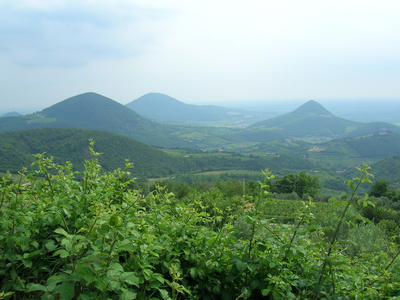
(View of the Euganean Hills)
Many a green isle needs must be
In the deep wide sea of misery
Or the mariner worn, and wan
Never thus could voyage on
Day and night, and night and day
Drifting on his dreary way
Alas I have nor hope nor health
Nor peace within, nor calm around
Nor that content surpassing wealth
The sage in meditation found
And walked with inward glory crowned
Many a green isle needs must be
In the deep wide sea of misery
Or the mariner worn, and wan
Never thus could voyage on
Yet were life a charnel where
Hope lay coffined with despair
Yet were truth a sacred lie
Love were lust, if liberty
Lent not life its soul of light
Hope its iris of delight
Truth its prophets robe to wear
Love its power to give and bear
Many a green isle needs must be
In the deep wide sea of misery
Or the mariner worn, and wan
Never thus could voyage on
Shelley’s years in Italy were marked by personal tragedy,
and the main chorus of this song was written in Este in 1818
in the Euganean hills after the death of his young daughter Clara in Venice.
The lines written in Naples were also written at a time of personal difficulty,
which scholars have not been able to fathom although it may be connected
with his mysterious `Neapolitan charge’. But the final lines from Hellas
reveal Shelley’s recourse to secular redemptive ideals based on liberty;
which he saw as more soundly based than religious beliefs.
10. THE FUNERAL
(Lyrics by John Webster, from Trelawny's account)
The quarantine officers stopped me
And sent me back to the quay;
Nonetheless Shelley and Williams
Kept heading out to sea
I watched till they disappeared into the haze
Then went down to my cabin to sleep;
I was woken by thunder and lightning
Coming crashing down over the deep.
And when the storm had cleared away
I looked where their boat had last been
Then I scanned the entire horizon
But they were nowhere to be seen.
(Mary Shelley: with us it was stormy all day
and we did not at all suppose that they could
put to sea …. Next day it rained and was calm
– the sky wept on their graves…')
Two weeks on I was cantering over
The Mediterranean sands;
Despair in the pit of my stomach -
And sweat in the palms of my hands.
I was riding along for miles and for miles
I was brought up short when I saw;
The lifeless body of Shelley
Lying there on the shore.
I rode back to Lerici
And there told Mary and Jane
That Shelley and Ned had been taken from them
By the sea and the wind and the rain
Then I built an iron furnace
And carried it down to the shore
Prepared the cremation of Shelley
As a crowd gathered silent in awe.
The air seemed to quiver and glisten
Twixt the sea and the Apennine;
Over his burning body I poured
Frankincense, salt and wine.
'My dear Trelawny' said Byron
Breaking the funeral's spell;
'I knew that you were a pagan
But you're a pagan priest as well !'
But not till the evening was on us
Was his body consumed on the pyre
All was consumed, except for his heart
Which I snatched from out of the fire.
And Mary is left with his papers,
And a question; she wonders how long
It will take for the world to realise
What it lost in this bright child of song.
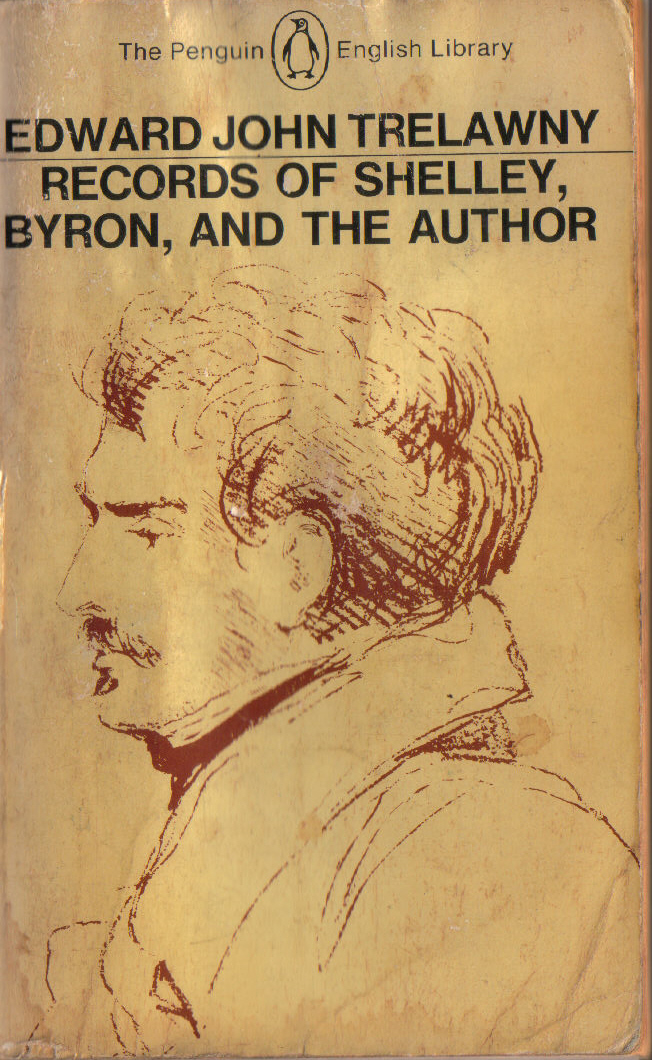
This song, sung by guest vocalist Keith Parker, summarises
Edward Trelawny's account of Shelley's death and his funeral
on the beach near Viareggio in his book 'Records of Shelley, Byron and the author'.
The Mary Shelley spoken piece over the instrumental is taken
from a letter she wrote to her friend Maria Gisborne from Pisa
as the funeral was taking place.
ADONAIS (SHELLEY)
Sources:
To Stella (adapted from Plato's epigram translated by Shelley)
Adonais, Ode to the West Wind
He was a morning star amongst the living;
Now that his spirit is fled;
He shines in the heavens
like the evening star
He gives new splendour to the dead.
He hath awakened from the dream of life
He hath outsoared the shadow of our night;
The soul of Adonais, burning like a star
Beacons from the abode where the eternal are.
(The spring does not rebel against the winter - it succeeds it;
The dawn does not rebel against the night - it disperses it.)
The One remains, the many change and pass
Life, like a dome of many coloured glass,
Stains the white radiance of Eternity.
O wind if winter comes can spring be far behind?
Can Spring be far behind?
O wind if winter comes can spring be far behind?
Can Spring be far behind?
O wind if winter comes can spring be far behind?
Can Spring be far behind?
This song may be the first time that Plato (in verse 1)
has ever been put to a backbeat! It's sung by Ruth Murray,
representing Mary Shelley paying tribute to her lost husband.
Two epigrams (thought to be) by Plato survive, evidence perhaps
of an early desire to be a poet/playwright.His evident failure
to succeed may have been why, in book 10 of The Republic,
he proposed banishing poets from his ideal state!
His epigram is a soulful tribute to a lost friend, Stella,
who 'gives new splendour to the dead'. The second verse, from Adonais,
plays on the old philosophical notion that perhaps this life is nothing but a dream.
The opening lines of Stanza 40
of Adonais are followed by the two final lines of the poem.
Adonais often comes to mind when the young and gifted suffer an untimely death;
examples could include Brian Jones of the Rolling Stones (Mick Jagger read pieces
from Adonais at the concert in Hyde Park), River Phoenix, Kirsty McColl,
Stephen Lawrence, or John Lennon. You could see Lennon
in Shelleyan terms as an 'unacknowledged legislator'
who now 'shines in the heavens like the evening star'.
In his poem A Terre (Being the Philosophy of many soldiers)
Wilfred Owen referred to Adonais (see stanza 42):
'I shall be one with nature, herb and stone', Shelley would tell me.
Shelley would be stunned: The dullest Tommy hugs that fancy now.
'Pushing up the daisies is their creed, you know'.
The spoken fragment comes from Shelley's notebook from Lerici,
and is significant in that it repeats the central idea from the
Ode to the West Wind. In other words the grim vision from The Triumph of Life,
written at the same time as the fragment, is not (as some say) a final descent
into pessimism on Shelley's part, but part of a longer work in which
sources for hope in a secular world would have been explored.
The third verse is a reprise of the platonic verse from Paradise of exiles,
and the final chorus is from the last line of the Ode to the West Wind.
It brings out the link between the Ode to the West Wind and Adonais:
at the beginning of the final stanza Shelley wrote
'The breath whose might I have invoked in song/ Descends on me ….'
– a reference back to the west wind in Florence.
Shelley called death 'the great mystery' and once apparently,
suggested to Jane Williams, when they were in a little dinghy in the
bay of Lerici, that they 'solve the great mystery together'.
She replied 'no thank you I'd like my dinner first'!
EPITAPH
Adapted from Childe Harold Canto IV Stanza 137

19th and 20th century views of Missolonghi, where Byron died in 1824
But I have lived, and have not lived in vain
My mind may lose its force, my blood its fire;
But there is that within me which shall tire
Torture and time, and breathe when I expire
Like the remembered tone of a mute lyre.
In 1818 Byron had published the last Canto of Childe Harold’s Pilgimage,
in which he included a reflection on what his legacy could amount to.
In an age when belief in an afterlife is on the wane these lyrics point
to an immortality of the spirit which certainly a great poet like Byron can aspire to.
What survives of the rest of us is perhaps less measurable,
but at best is seen perhaps in a diffused but none the less real contribution
to humanity, liberty, and society, that goes on to build up the human story
– for all we know, the only self-aware form of life in the universe.
THE WORLD'S GREAT AGE
Sources:
Hellas
Prometheus Unbound, Act III
The Question, Shelley’s Lerici notebook,
Lines written among the Euganean Hills
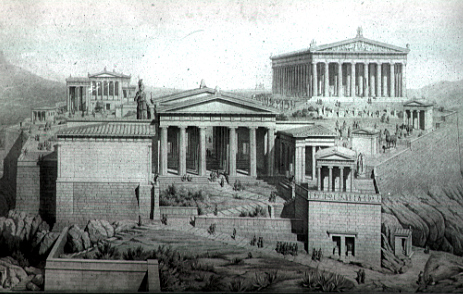
Illustration reconstructing 5th century Athens
- what Shelley saw, with some qualifications,
as 'The World's Great Age'.
The world's great age begins anew
The golden years return;
The earth doth like a snake renew
Her winter weeds outworn.
Heaven smiles, and faiths and Empires gleam;
Like wrecks of a dissolving dream.
The loathsome mask has fallen;
The man remains
King over himself
Free from guilt and pain
Women frank and beautiful and kind;
Looking emotions once
they feared to feel
Speaking the wisdom once they dared not speak
Changed to all which once they dared not be
I dreamed that as I wandered by the way
Bare winter suddenly was changed to spring
Let the tyrant rule
The desert he has made
Let the free possess
The paradise they claim
Where all shall live
As equals and as friends;
And the world grow young again.
The world's great age begins anew
The golden years return;
The earth doth like a snake renew
Her winter weeds outworn.
This song gathers together Shelley's utopian verses
from a variety of sources. Matthew Arnold derided Shelley
as an ‘ineffectual angel’ but modern historians
have shown how his visionary verses made a significant contribution
to the attainment of universal suffrage in Britain through their influence
on key groups like the Chartists and the Suffragettes.
So Shelley leaves this collection in idealistic mode.
He understood the value of a vision, but saw its achievement
as subject to 'the difficult and unbending realities of actual life'.
As he put it to Leigh Hunt in the dark days after the Peterloo massacre:
'You know my principles incite me to take all the good I can get in politics,
for ever aspiring to something more. I am one of those whom nothing
will fully satisfy,but who is ready to be partially satisfied
by all that is practicable'.
SO WE’LL GO NO MORE A ROVING
So we’ll go no more a roving,
So late into the night;
Though the heart be still as loving
And the moon be still as bright.
For the sword outwears its sheath
And the soul outwears the breast;
And the heart must pause to breathe
And love itself have rest
Though the night was made for loving
And the day returns too soon
Yet we’ll go no more a roving
By the light of the moon.
Though the night was made for loving
And the day returns too soon
Yet we’ll go no more a roving
By the light of the moon.
One of Byron’s most famous lyrics, whose jumping off point was a
contemporary Scottish folk song, is pressed into service as a farewell song
for the younger Romantics: Keats, Shelley and now Byron who had all died young.
They had all died freethinkers, unreconciled to orthodox formulations of God;
in a sense today’s society, which also finds simple all-explanatory
formulas problematic, has only just caught up with them.
Romantic poetry has been called ‘a fusion of love, philosophy, exact
observation and spiritual vision’ (Grevel Lindrop) which doesn’t seek
to express a coherent system of thought but reflects a ‘painfully
fragmented existence’ (Richard Cronin). Which is a good cue
for a last quotation from Byron: ‘When a man talks of system’,
he once wrote, ‘his case is hopeless”.